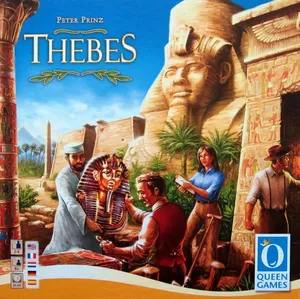
館藏編號 421
底比斯的遠方
Thebes
- 人數
- 2–412345678+推薦 2–4 人(最佳 3–4)
- 時間
- 60分鐘
- 重度
- 2.2/5中
- BGG 評分
- BGG 評分7.1/1010,316 票
- 年齡
- 8+
- 年份
- 2007Peter Prinz
扮考古學家在時間軌上分配週數,跑遍歐非中東挖寶的主題輕策
學習曲線
移動、學知識、挖寶三種行動,十分鐘能講完
時間軌決定誰先動,第一次容易忘記挖久會少好幾手
知識與挖掘時數的配比抓到後,剩下多半靠手氣
AI 整理
玩家是互相較勁的考古學家,在歐洲、北非與中東之間奔波,先到各大城市累積對五個古文明的知識,再帶著知識到遺址開挖。整個遊戲跨越兩到三年,每個行動都要花掉「週數」:城市之間移動一週、學知識依等級計時、實際開挖則看你打算待幾週。誰的標記在時間軌上落後最多,誰就是下一個行動的人。
這條時間軌是整款遊戲的靈魂。你可以在遺址窩上十週狂挖,但那段時間對手會連做好幾個行動,把好牌與好展覽全部撿走——每一次選擇都是「這件事值得我用掉多少人生」。挖寶則從袋子裡抽,袋中除了文物還有沙土,你對該文明的知識越高,能抽的次數越多;抽到的沙土會放回袋中,所以先下手的人期望值明顯較好。這個抽袋機制帶來很直接的賭博快感,也是它最受爭議的地方。
放在同類作品裡,它比卡坦島輕一點、規則更單純,接近入門與中量之間;比璀璨寶石多了主題與空間感,但策略深度反而更淺。它賣的是體驗而不是最佳化。
沒玩過桌遊的人:規則十分鐘講得完,適齡八歲以上,是很順的第一款。喜歡主題大於算分的人:從袋子裡摸出寶物的那一刻,遊戲的全部魅力都在這裡。追求公平競技的重度玩家:抽袋運氣影響很大,容易玩得不服氣。
開玩前注意:二到四人皆可,BGG 認為三到四人最好,兩人局競爭壓力會鬆掉不少。一局約一小時。盒標與 BGG 玩家投票都是八歲以上。幾乎不需要閱讀文字,所以雖然沒有中文版,直接玩外文版並不影響。心理準備方面請先講清楚:這是一款會出現「挖十週結果全是沙」的遊戲,先說好大家才笑得出來。
內容由 AI 依公開資料整理,可能有誤,僅供挑選參考。
玩家怎麼說
喜歡的人幾乎都是被主題收服的:規則與擺設都簡單、主題味濃、遊戲時間與樂趣的比例好,很適合帶新手入坑,也有人說跟家人玩很順。「雖然抽文物運氣很重,但主題夠好,可以原諒」是相當典型的評價。
保留意見最集中在運氣。有玩家指出除了固定拿分的講座之外,其餘幾乎都是賭博,挖很久卻一無所獲的情況並不少見,甚至有人形容整局像在抽獎。因此也有玩家自訂家規,例如抽到全沙就從袋中移走一塊沙土,不過效果被認為有限。另有玩過十幾次的人表示策略偏單調、重複感會出現,長期耐玩度不如預期。
總結:把它當成一款氣氛好、笑聲多的入門主題遊戲會很滿意;想找講求控制與最佳化的競技型策略,這款不會是答案。
規格明細
- 語言
- 英文
- 文字用量
- 幾乎沒有文字
- 中文化狀態
- 未中文化
- 類型
- 主遊戲
- 年齡
- 8 歲以上
外部資源
BGG 原文介紹(英文)
Thebes is a game of competitive archeology. Players are archaeologists who must travel around Europe, northern Africa, and the Middle East to acquire knowledge about five ancient civilizations -- the Greeks, the Cretans, the Egyptians, the Palestinians, and the Mesopotamians -- and then must use this knowledge to excavate historical sites in the areas of these civilizations. Through the course of the game, expositions are revealed, and an archaeologist who has treasures from the requisite civilizations may claim the prize (this is a change from the first edition's handling of exhibitions). The archaeologist who learns the most about the civilizations, claims the greatest-valued artifacts, and collects the most exhibitions will win out over his or her colleagues. The key element to the game is that it is played out over a period of two (or three) years, and each action a player performs takes a certain amount of time -- traveling is a week between cities, gathering knowledge takes time for the level of the knowledge, and actually digging at a cultural site takes time to yield a certain number of artifact tiles. The game uses a novel mechanism to keep track of this. There is a track of 52 spaces around the outside of the board. Each time a player moves and takes an action, he or she moves their player token forward in time. Players take turns based on being the one who is furthest back in "time". So, a player can go to an excavation site and spend 10 weeks digging for artifacts, but that will also mean that the other players will likely be taking several actions in the interim while that player waits for the "time" to catch up. In addition, the artifact tiles for each civilization are drawn from a bag that also contains dirt. When a player excavates a site, that player pulls tiles from the bag, but some may only be worthless dirt instead of valuable treasure. That dirt is then returned to the bag, making the first draw more likely to provide useful tiles. This is the new entry for the Queen printing of Jenseits von Theben. As the new game changes several mechanisms of the original, and is available in a much wider release, the two games should be regarded as separate entities. Re-implements: Jenseits von Theben