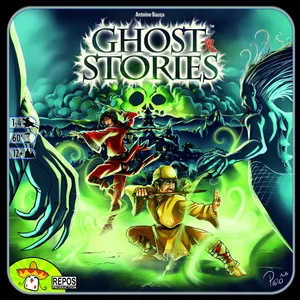
館藏編號 185
聊齋
Ghost Stories
- 人數
- 1–412345678+推薦 1–4 人(最佳 4)
- 時間
- 60分鐘
- 重度
- 2.9/5中
- BGG 評分
- BGG 評分7.2/1021,925 票
- 年齡
- 12+
- 年份
- 2008Antoine Bauza
四位道士守村驅鬼、難到令人上癮的骰子合作遊戲
學習曲線
規則書寫得零散,鬼怪與角色能力得一條條講清楚
第一局常被鬼海淹沒,搞懂時通常已經輸了
要練到全隊協調用道符與陷阱,才有機會贏
AI 整理
玩家扮演守在村子四邊的道士,合力擋下地獄之王吳峰派出的鬼群,最後還要打倒他本人才算贏。每個人的回合先從牌堆抽一隻鬼放到棋盤邊緣,鬼會纏住村莊格子、封住那格的功能,或是逼你擲詛咒骰;接著道士才移動,到某格用村民的幫助,或是對相鄰的鬼進行驅魔。驅魔就是擲三顆道骰,骰出的顏色湊滿鬼的抗性就成功,不夠可以補上手上的道符。
真正讓這款難忘的是它的壓力節奏。鬼是每回合固定進場的,你清得比它們來得慢,棋盤就一格一格失守,三格被纏住直接輸;牌堆抽完吳峰還在也輸;道士全滅還是輸。輸法比贏法多得多,於是每個回合都在算「這隻先打還是那隻先擋」,四個人得真的商量,不是各打各的。四種角色能力不同,村莊格子的位置每局重排,重來一次感覺就不一樣。
和瘟疫危機相比,它更重也更殘忍:瘟疫危機讓你有喘息與翻盤的窗口,這款則是從頭壓到尾,而且勝負最後仍要靠骰子。喜歡合作遊戲但受不了運氣的人要先有心理準備。
喜歡被遊戲電的合作老手,會愛上它那種一路下坡、每秒都在補洞的緊繃感。吃東方民俗與鬼怪主題的人,美術和氣氛做得很到位。想找第一款合作遊戲的家庭建議先跳過,難度和陰暗主題對新手都不友善。
開玩前注意:四人是公認最佳,也有玩家建議人少時直接用四人規則來玩,不然難度會失控;一到三人官方也支援,單人評價不錯。一局約六十分鐘,但常常會提早結束——因為輸了。年齡標示 12 歲以上,BGG 玩家的看法也一樣。卡面幾乎不需要讀字,問題出在規則書:目前沒有中文版,能力敘述與規則本身都被玩家抱怨過寫得不清楚,開場前最好有人先把規則整理成一張速查表。
內容由 AI 依公開資料整理,可能有誤,僅供挑選參考。
玩家怎麼說
多數玩家的共識很一致:題材漂亮、機制緊湊,但「非常非常難贏」。有人形容它像「坐著沒有煞車的推車滾下坡,每一秒都得同時控制所有東西」,也有人說正因為一直輸,一局其實跑得很快。有玩家強調四人是最好的人數,甚至建議少人時也照四人規則玩,否則幾乎不可能過關。
抱怨集中在兩點。第一是規則書,好幾則評論直說看原文規則自學會卡住,角色能力也寫得含糊,得靠網路上的補充說明才理得清。第二是難度可能把樂趣磨掉,有人因此把遊戲賣掉,覺得帶小孩玩不來。
想找一款會逼你們全隊繃緊神經的合作遊戲,它很對味;想輕鬆同樂或帶新手入門,建議另尋他款。
規格明細
- 語言
- 繁體中文
- 文字用量
- 幾乎沒有文字
- 中文化狀態
- 未中文化
- 類型
- 主遊戲
- 年齡
- 12 歲以上
外部資源
BGG 原文介紹(英文)
Ghost Stories is a cooperative game in which the players protect the village from incarnations of the lord of hell – Wu-Feng – and his legions of ghosts before they haunt a town and recover the ashes that will allow him to return to life. Each Player represents a Taoist monk working together with the others to fight off waves of ghosts. The players, using teamwork, will have to exorcise the ghosts that appear during the course of the game. At the beginning of his turn, a player brings a ghost into play and places it on a free spot, and more than one can come in at the same time. The ghosts all have abilities of their own – some affecting the Taoists and their powers, some causing the active player to roll the curse die for a random effect, and others haunting the villager tiles and blocking that tile's special action. On his turn, a Taoist can move on a tile in order to exorcise adjacent ghosts or to benefit from the villager living on the tile, providing it is not haunted. Each tile of the village allows the players to benefit from a different bonus. With the cemetery, for example, Taoists can bring a dead Taoist back to life, while the herbalist allows to recover spent Tao tokens, etc. It will also be possible to get traps or move ghosts or unhaunt other village tiles. To exorcise a ghost, the Taoist rolls three Tao dice with different colors: red, blue, green, yellow, black, and white. If the result of the roll matches the color(s) of the ghost or incarnation of Wu-Feng, the exorcism succeeds. The white result is a wild color that can be used as any color. For example, to exorcise a green ghost with 3 resistance, you need to roll three green, three white, or a combination of both. If your die rolls fall short, you can also use Tao tokens that match the color in addition to your roll. You may choose to use these after your roll. Taoists gain these tokens by using certain village tiles or by exorcising certain ghosts. One of the Taoists has a power that allows him to receive such a token once per turn. To win, the players must defeat the incarnation of Wu-Feng, a boss who arrives at the end of the game. There are also harder difficulty levels that add more incarnations of Wu-Feng, in which to win, you must defeat all of them. There are many more ways to lose, however. The players lose if three of the village's tiles are haunted, if the draw pile is emptied while the incarnation of Wu-Feng is still in play, or if all the priests are dead.