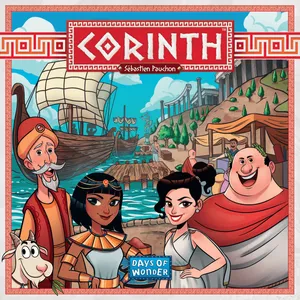
館藏編號 99
科林斯
Corinth
- 人數
- 2–412345678+推薦 2–4 人(最佳 3)
- 時間
- 20–30分鐘
- 重度
- 1.6/5輕
- BGG 評分
- BGG 評分6.7/103,505 票
- 年齡
- 8+
- 年份
- 2019Sébastien Pauchon
在古希臘市集搶骰子填貨攤、順便讓管家在格子裡繞出分數的骰寫小品
學習曲線
擲骰、依點數分層、選一層拿走,十分鐘能講完
貨攤要填滿才能換區、管家不能走回頭路要提醒一下
何時花金幣加骰、何時走管家,幾局後就抓得到節奏
AI 整理
背景設在西元前四世紀的科林斯市集,玩家扮演商人搶生意。輪到的人擲九顆骰子,把點數最高的那些放到最上層的金幣格,其餘依點數從低到高分層排開;接著所有人依序挑一層,把那一層的骰子全部拿走,並執行對應的行動——最上層拿金幣、最下層拿山羊、中間幾層則是把貨物送進自己紙張上的攤位。骰子數量就是行動力,拿到愈多顆做得愈多。十幾個回合後結算,依貨物、管家走過的格子、蓋好的建築以及手上剩餘的資源計分。
有意思的是每回合的取捨:骰子公開分好層,你看得到哪一層最肥,但別人也看得到,而且輪到你時好層可能已經被拿走。想提高機率,可以花金幣加擲黃色骰子拉高某一層的數量,不過如果你自己最後沒拿那層,那些骰子會直接移除,別人也占不到便宜——這個小設計讓加骰變成一種帶點賭氣的攻防。另一條線是管家:你可以放棄拿貨,改用骰子點數在五乘五的格子裡移動,而且不能走過自己畫過的線,每次停在角落就依照走過的格數計分,前面繞得愈多,後面每次結算就愈可觀。走短線穩收貨物還是繞遠路養管家,是全場最主要的決策。
放在同類作品裡,這是輕量的家庭級骰寫遊戲,比璀璨寶石更輕、比卡卡頌更快,一局二三十分鐘就結束。它不像很多骰寫作品那樣人人同時填自己的表,而是把骰子做成搶奪的對象,所以桌上還是有互相卡位的感覺,只是不至於傷感情。
第一次接觸骰寫類型的人,規則短、流程直觀,一局就能理解全部運作。想找短時間家庭遊戲的人,標示八歲以上,大人小孩都能同桌。追求深度的重度玩家要有心理準備,決策空間有限,運氣的比重不低。
開玩前注意:三人是甜蜜點;兩人時骰子太多、幾乎人人都能拿到想要的那層,張力會明顯下降,有玩家提到這一點。四人則每回合等待稍長。實際二十到三十分鐘。盒標 8 歲以上,BGG 上的投票也落在 8 歲。遊戲中幾乎不需要讀字,圖示看得懂就能玩,而且有中文版。紙張是消耗品,常玩的話要留意補充,想省紙也可以護貝後用白板筆重複使用。
內容由 AI 依公開資料整理,可能有誤,僅供挑選參考。
規格明細
- 語言
- 繁體中文
- 文字用量
- 幾乎沒有文字
- 中文化狀態
- 中文版
- 類型
- 主遊戲
- 年齡
- 8 歲以上
外部資源
BGG 原文介紹(英文)
Under a blazing sun in 4th century BCE, traders come from all corners of the Mediterranean Sea to Corinth to sell their goods; Persian carpets, Cretan olive oil, Roman grapes, and Egyptian spices are highly prized by traders. Players have a few weeks to secure their place in Corinthian lore as its most savvy trader! Corinth is a roll-and-write game akin to a dice-only version of the board game Yspahan. At the start of a turn, the active player rolls nine dice, then places all the dice with the highest value on the gold space at the top of the chart, then starts placing dice from the bottom of the chart up, with each value of dice being on a separate level. The active player takes all the dice on one level, then the action associated with that level. The top level gives the player as many gold as the number of dice they took; the bottom level gives goats instead of gold; and the middle levels allow a player to deliver goods to a number of market stalls on their personal player sheet equal to the dice claimed. (You have four colors of market stalls, and once you start marking off, say, rugs in one of the blue areas, you have to finish marking off all the rugs in that area before you can start marking off another blue area.) The active player can spend gold to roll up to three extra yellow dice and thereby increase the odds of getting to take a desired level; if the active player doesn't take any of these yellow dice, they are removed from play, preventing others from benefitting at that player's expense. Instead of marking off gold, goats, or goods, you can use the value of the die or dice claimed (1-6) to move the steward on your personal score sheet. The steward starts in the middle of a 5x5 grid on your sheet, and you must move it as many spaces as the number of pips on the die value claimed, not crossing over any line you've drawn previously. You can pay 1 gold to move the steward one more or one fewer space, and you can pay as much gold as you want to do this. You can receive gold, goats, or goods from where the steward stops, but beyond that, you can earn points. When the steward stops on a corner space of this grid, you count the number of spaces circled to this point, with some spaces counting twice, then you write down that number, scoring that many points at game's end. If you stop in another corner later, you do the same thing again, which compounds the value of all your previous movement. You can spend gold or goats to construct buildings that give you bonus powers, such as collecting two additional gold whenever you collect any gold or moving the steward up to two spaces more or less without paying. After 16 turns (with four players) or 18 turns (with two or three players), the game ends and you tally points for goods delivered, spaces visited by the steward, buildings constructed, and goats and gold still on hand.